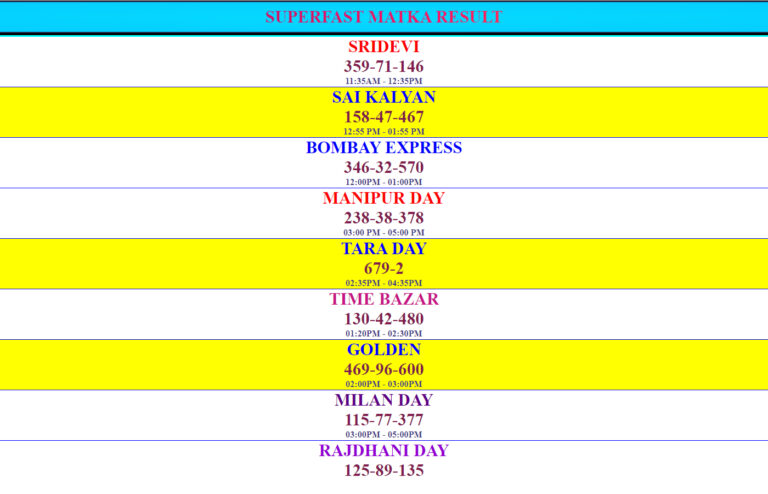

IPL Betting and the Rise of Satta Matka Records: Trends, Risks, and Regulations
Introduction
The Indian Premier League (IPL) has transformed cricket from a traditional sport into a global entertainment spectacle. With its packed stadiums, high‑octane performances and massive television audiences, the tournament has also become a magnet for betting activity. While mainstream sportsbooks operate under strict licensing regimes, a parallel underground market—most notably the satta matka records—has flourished, offering bettors unconventional avenues to wager on match outcomes, player statistics, and even minute‑by‑minute in‑play events. This article provides a comprehensive analysis of IPL betting within the context of satta matka, examining historical roots, legal frameworks, risk considerations, technological influences, and future trajectories.
Historical Intersection of Cricket and Satta Matka
The origins of satta matka trace back to the 1960s when Indian lottery agents in Mumbai began accepting bets on the opening and closing rates of cotton traded on the wholesale market, known locally as “matka.” Over time, the game evolved into a number‑based gambling system that leveraged random draws and secret codes. As cricket rose to prominence in the 1970s and 1980s, bettors recognized the sport’s potential for profit, integrating cricket scores and player performances into the matka framework.
When the IPL launched in 2008, it offered a new, lucrative platform for satta operators. The league’s short, high‑intensity format—typically 60 matches over two months—produced abundant data points for analysis, making it ideal for rapid betting turnover. This convergence of a popular sport and an entrenched gambling culture created a symbiotic relationship wherein matka agents provided bespoke betting options that mainstream bookmakers could not match, such as “run‑out” wagers on a specific wicket or “over‑under” predictions for a single over.
Current Market Dynamics and Betting Products
Today, IPL betting is a multi‑billion‑rupee industry, with legal operators reporting exponential growth during the tournament season. However, a substantial shadow market persists, driven by the anonymity and flexibility of satta matka networks. Bettors can place wagers through WhatsApp groups, private messaging apps, and even encoded SMS services, bypassing formal registration and KYC protocols. The range of betting products in this arena includes:
- Traditional match‑winner and series‑winner markets.
- Player‑specific props such as total runs, wickets, or catches.
- Micro‑events like the number of sixes in a single over.
- Live‑in‑play “instant” bets that settle within seconds of a ball being bowled.
These products are often packaged as “special numbers” that correspond to particular outcomes, a practice uniquely associated with the matka tradition. For instance, a “four‑four‑six” sequence might represent a bettor’s prediction that a batsman will hit two fours followed by a six in a specific over.
Legal and Regulatory Environment
The legal status of betting on cricket varies dramatically across Indian states. While a few jurisdictions, such as Sikkim and Goa, have authorized regulated sports betting, the majority of the country still classifies gambling as illegal under the Public Gambling Act of 1867. This legislative ambiguity has fostered a thriving underground market, where satta matka operators thrive on the margins of enforcement.
Regulators face significant enforcement challenges. First, the decentralized nature of matka networks—often operating through personal contacts and encrypted messaging—makes detection difficult. Second, the rapid turnover of betting cycles during the IPL compresses investigative timelines. Finally, the cultural acceptance of matka as a “social pastime” in certain communities impedes public cooperation with law enforcement.
In response, the Ministry of Home Affairs has issued periodic advisories urging states to strengthen anti‑gambling provisions, and several high‑profile raids have targeted large matka syndicates. Nonetheless, the resilience of the network, bolstered by technology and community trust, ensures its continued presence throughout the IPL season.
Risk Management for Bettors
Engaging with satta matka for IPL betting carries inherent financial and legal risks. To mitigate these, bettors should adopt disciplined strategies:
- Bankroll Allocation: Treat betting capital as a finite resource. Allocate only a small percentage (typically 1‑2%) of the bankroll to any single wager, preserving liquidity for future opportunities.
- Data‑Driven Analysis: Leverage publicly available statistics—player form, pitch conditions, head‑to‑head records—to inform predictions rather than relying solely on intuition or superstition.
- Limit Exposure to Live Bets: While live‑in‑play betting offers excitement, the rapid pace can lead to impulsive decisions. Set predefined limits for live wagers and adhere to them.
- Verification of Operators: Although matka operates informally, bettors can assess credibility through community reputation, historical payout records, and the transparency of communication channels.
- Legal Awareness: Understand the jurisdictional stance on gambling. In states where betting is prohibited, participation can result in fines, asset seizure, or criminal prosecution.
Technological Platforms and Data Analytics
Technology has accelerated the integration of matka betting with modern IPL wagering. The most noticeable advancement is the use of WhatsApp groups, which provide instant communication, rapid odds dissemination, and real‑time updates. One notable contact point for bettors is the cricbet365 id whatsapp number, a hub where participants receive curated betting suggestions and market odds tailored to the IPL schedule.
Beyond messaging platforms, sophisticated data analytics tools have emerged. Operators now employ algorithmic models that ingest historical IPL data, player injury reports, and weather forecasts to generate probabilistic outcomes. These models are often presented to bettors as “secret formulas” or “lucky numbers,” though their statistical foundation remains similar to mainstream sportsbook odds-making.
Artificial intelligence also plays a role in detecting anomalies in betting patterns, which can signal match‑fixing attempts or insider information leaks. While these systems are more prevalent among regulated entities, some advanced matka syndicates have begun adopting similar analytics to refine their offerings, thereby raising the overall sophistication of the underground market.
Ethical Considerations and the Social Impact
The proliferation of IPL betting through satta matka raises several ethical questions. First, the allure of quick profit can encourage gambling addiction, particularly among younger fans drawn to the glamour of the IPL without comprehending the financial hazards. Second, the opacity of matka operations can facilitate money‑laundering activities, as illicit funds are channeled through seemingly innocuous betting transactions.
Community leaders and NGOs have advocated for responsible gambling initiatives, emphasizing education, self‑exclusion programs, and accessible helplines. However, the informal nature of matka makes the implementation of such safeguards challenging. A constructive approach may involve collaborative efforts between state regulators, legitimate betting operators, and community influencers to promote transparency and responsible participation.
Future Outlook for IPL Betting and Satta Matka
Looking ahead, several trends are likely to shape the intersection of IPL betting and satta matka:
- Regulatory Liberalization: As some Indian states experiment with legalized sports betting, a portion of the matka market may migrate to licensed platforms, offering greater consumer protection.
- Hybrid Betting Models: Operators could blend traditional matka practices with digital wallet integrations, allowing seamless deposits and withdrawals while preserving the cultural elements of matka.
- Enhanced Data Transparency: Open‑source analytics and community‑driven data repositories may empower bettors with better information, reducing reliance on rumor‑based predictions.
- Targeted Enforcement: Advanced surveillance tools and inter‑state coordination could disrupt large‑scale syndicates, though smaller, decentralized networks are likely to persist.
Crucially, the sustainability of the matka ecosystem will depend on its adaptability to evolving legal frameworks and technological advancements. Bettors who remain informed, practice disciplined risk management, and respect the legal landscape will be best positioned to navigate the dynamic environment of IPL wagering.
Conclusion
The IPL stands as a cultural phenomenon that fuels a diverse betting ecosystem, ranging from regulated sportsbooks to the clandestine world of satta matka. Understanding the historical roots, legal nuances, risk factors, and technological influences is essential for anyone involved in this space—whether as a bettor, regulator, or industry observer. By embracing responsible practices and staying abreast of regulatory developments, participants can enjoy the excitement of IPL betting while mitigating the associated pitfalls. For those seeking direct engagement within the matka network, established contact points such as the goldenexch99 id whatsapp number continue to serve as gateways to the vibrant, though contentious, world of Indian cricket wagering.